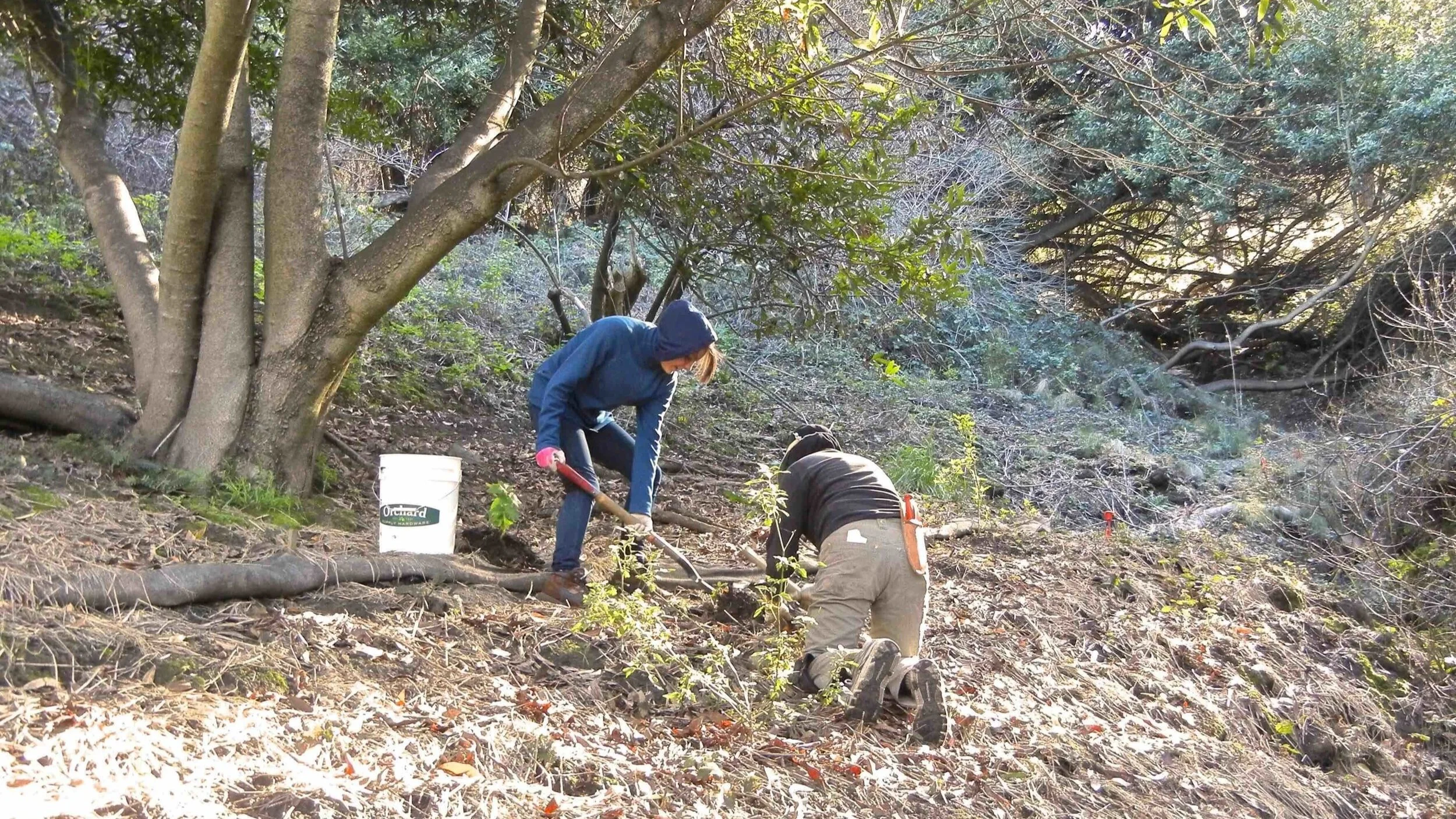
For the last two years rainy weather forced us to cancel the Conservancy’s winter bird walk. More of the same seemed likely this year when we had plenty of rain during the preceding week. But the forecast for Sunday looked promising
Alameda whipsnake/striped racer research project, by Jessica Sheppard
Claremont Canyon Regional Preserve is hosting a research project focused on the Alameda whipsnake (Masticophis lateralis euryxanthus), also sometimes referred to as the Alameda striped racer (Coluber lateralis euryxanthus). This elusive and speedy snake is protected at the state and federal level and may be found in the park.
Art installation features view from Claremont Canyon, by Marilyn Goldhaber
Spring in the canyon and update on fire safety work, by L. Tim Wallace
Keeping abreast of Claremont Canyon, by Marilyn Goldhaber
There are many ways to keep abreast of the goings-on in Claremont Canyon—and also in its surrounding neighborhoods. If you are interested mainly in the wildlands of Claremont Canyon and the activities of the Claremont Canyon Conservancy, including our hikes, stewardship projects, trail upkeep, and wildfire safety, we have a monthly one-page newsletter that we send out by email to our members and anyone else who signs up for the service.
Winter bird walk with Dave Quady, by Kay Loughman
Restoring a north coastal grassland, by Marilyn Goldhaber
Spring Bird Walk: this morning in Claremont Canyon, by Dave Quady
Birds and birding in Claremont Canyon, by Kay Loughman
Winter birding field trip, by Kay Loughman
A botanical exploration with Lech Naumovich, by Marilyn Goldhaber
Native plants at the Pacifica site with Jake Sigg, by Marilyn Goldhaber
A DOZEN CONSERVANCY MEMBERS AND FRIENDS visited the Pacifica Foundation site of the KPFA Radio Towers overlooking Gwin and Claremont Canyons, with Jake Sigg, long-time advocate of native plant restoration in the Bay Area and author of the widely read “Nature News from Jake Sigg.” Jake helped us identify native plants and provided insights on the landscape, a naturally rough and exposed knoll overlooking much of the bay area to the west and Mount Diablo and the inner valley to the east.
Found: 1895 Alameda-Costra county boundary marker, by Mary Millman
SOMETIMES IMPORTANT THINGS end up in unexpected places. In 1895 several 400-pound cast iron boundary markers were placed along the ridgetop boundary between Alameda County and Contra Costa County. One was positioned right at the top of Claremont Canyon, close to what we know as “Four Corners,” the intersection of Grizzly Peak Boulevard and Claremont Avenue/Fish Ranch Road.
Twentieth century canyon dwellers, by Mary Millman
ALTHOUGH WE ARE NOW IN THE MIDST of a comprehensive project to collect an audio history of Claremont Canyon, the beginnings sprang from a casual curiosity about the early days in the canyon. Our board member, Tamia Marg, who spent her childhood there remembered “Tappy” Marron, whose family built the house that the Park District now occupies at the end of Gelston Road.
Wild life in the North Hills - the website, by Kay Loughman
A year or two ago I was greatly influenced by a couple of books (“Bowling Alone” and “Better Together”) by a Harvard scholar named Robert D. Putnam. He makes the case that decreasing involvement in community life is bad for individuals and ultimately bad for the world—a gross oversimplification on my part. But, as one who tends to sit at the computer by myself rather than do anything in the community, I knew Putnam’s message was aimed at people like me
A buffer zone in Claremont Canyon as a cultural landscape, a personal perspective, by Bill McClung
For many years I have believed we need a substantial fuel-reduction zone– similar in scale to the Tilden Fuelbreak at the edge of North Berkeley–in the complex two miles of wildland-urban intermix in Claremont Canyon. This idea runs up against practical, aesthetic, jurisdictional, and inertial challenges that may be overcome if we can begin to think of such a buffer zone as a cultural landscape.
In August, the Berkeley Architectural Heritage Association hosted a series of walks and talks concentrating on Strawberry Canyon as a cultural landscape. Walks—or rambles as they called them—occurred on Panoramic Hill, at the Botanical Garden, and along the Upper Jordan Trail, which connects to the Ridge Trail above Claremont and Strawberry Canyons.
Winter mushroom walk, by Martin Holden
In January, noted Bay Area mycologist Robert Mackler led one of his popular fungal forays into the moist oak forests of Garber Park. A past president of the Mycological Society of San Francisco, Bob Mackler has been explaining the mysteries of mushrooms to since the 1970’s. Bounding through the wintery woods in his big boots and mushroom-dyed cap, he resembled a real-life Tom Bombadil. We were only a few paces into the park before we discovered our first fungus— a log festooned with Tukeytails (Trametes versicolor).
Sulfer Shelf, by Martin Holden
The Chert Wall, by Martin Holden

Tale of the tapping towhee, by Marilyn Goldhaber
At first, I wondered if my husband had a secret admirer. I could hear a tapping at the window of his study, like someone wanting to get in. But when I went to investigate, no one was there. Then again— tap, tap, tap— and I saw him, a chubby, brown bird earnestly pecking and flapping at his own reflection.
