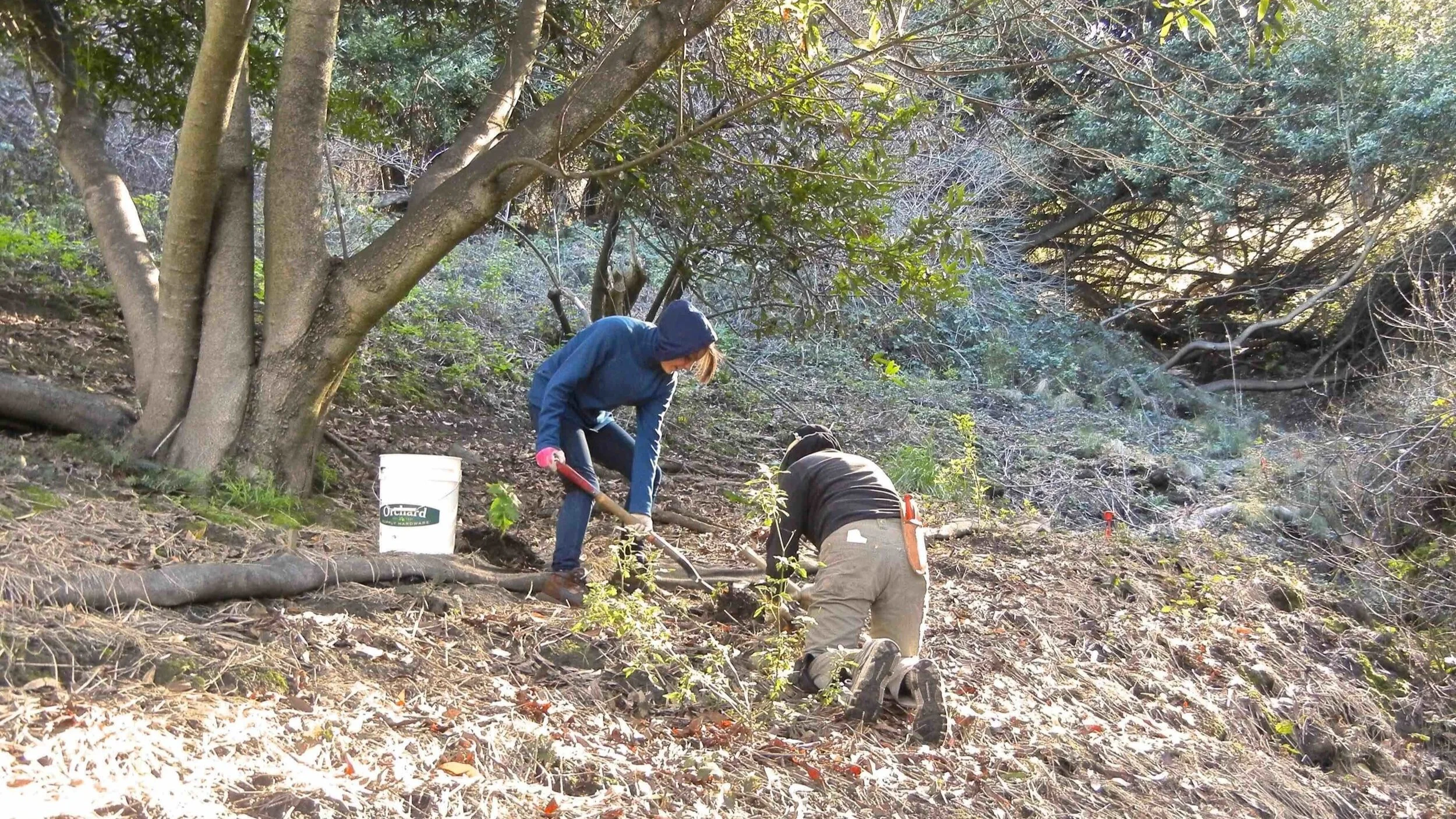
The East Bay Regional Park District took a major step forward this week in its long-term public safety efforts to reduce fire hazards in the East Bay Hills by accepting $4.65 million in federal grants to reduce dangerous trees and foliage in the hills from Oakland north to Richmond.
Reduce the fire hazard, don't litigate, by L. Tim Wallace
After 10 years, FEMA finally has issued its Record of Decision (ROD) on grants to reduce the fire danger posed by the eucalyptus trees in Claremont Canyon and the East Bay Hills. The ROD is not ideal. The Claremont Canyon Conservancy would have preferred the original draft that enabled the three grant applicants (UC Berkeley, the City of Oakland and the Regional Park District) to use the funds as each saw fit, rather than requiring all three grantees to use a “unified approach.”
FEMA releases final EIS, by Jon Kaufman
On December 1, FEMA released the Final Environmental Impact Statement that sets conditions that must be followed by the University of California and the City of Oakland and the East Bay Regional Park District as they move forward with eucalyptus removal. The Conservancy has not yet examined the document in detail but here's our initial impression.
President's message: Conservancy update, by L. Tim Wallace
April 2014 fire in the canyon, by Joe Engbeck

THE ALARM SOUNDED AT 11:21 am. A fire of unknown size and origin was burning in Claremont Canyon. The cell- phone caller who was first to alert the Oakland Fire Department, reported a lot of smoke in the upper canyon not far from the intersection of Claremont Avenue, Grizzly Peak Boulevard and Fish Ranch Road. It was Tuesday, January 21, 2014—well into the driest winter ever recorded in the East Bay.
EIS talking points regarding eucalyptus removal program
Costs for growing large eucalyptus trees will sky-rocket, by Jerry Kent
AGENCY DECISIONS ABOUT GROWING large blue gum eucalyptus trees may be as risky as Frank Havens’ Mahogany Eucalyptus and Land Company of the early 1900s. That enterprise ultimately went belly-up when Havens’ 3,000 acres of eucalyptus trees in the East Bay Hills failed to become a “gold mine,” proving to be unusable for hardwood lumber.
Awaiting FEMA's release of the draft EIS, by L. Tim Wallace
Claremont Canyon's many landowners take responsibility
DO YOU KNOW THAT CLAREMONT CANYON has many landowners? The two major landowners are the University of California, which owns the upper 150 acres of our mostly wildland canyon and the East Bay Regional Park District, which owns the lower 208-acres (including Gwin Canyon) best known for the dramatic Stonewall-Claremont hiking trail.
Interview with Jon Keeley, by Joe Engbeck
President's message, by L. Tim Wallace
IT IS MY PLEASURE TO ANNOUNCE that Jon Keeley has agreed to be the featured speaker at our annual meeting on Sunday, November 4. Dr. Keeley last spoke to the Conservancy in the autumn of 2007—five years ago—so we’re pleased to have him back again to discuss the most important new findings in the field of wildfire behavior, climate, and local conditions.
A tenth anniversary, by L. Tim Wallace
From the president's desk, by L. Tim Wallace
THIS WILL BE THE CONSERVANCY’S TENTH YEAR anniversary, and we want to celebrate it with you—not only on November 6th at our Annual Meeting (mark your calendars), but throughout the year. At each of our nature walks, at each of our stewardship days where ever they may be in Claremont Canyon, at each of our special events, we all hope you join us and become part of the discussion about the local treasure that is Claremont Canyon.
Honoring our members, by Marilyn Goldhaber
HONORING OUR MEMBERS: From our founding in 2001, we have encouraged nearby residents and community organizations to support the Conservancy by becoming Founding Sponsors with a commitment to contribute $1,000, either all at once or over ten years. We are pleased to list in our Spring 2011 newsletter, in approximately the order the commitments were made, our first 209 Founding Sponsors.
President's message, by Barry Pilger
AS SUMMER TURNS TO FALL Claremont Canyon can take on a special beauty after our recent relatively wet spring and mild summer. A drive up Claremont Avenue, or better yet a walk onto a canyon trail, whether through Garber Park, from Four Corners to the chert, or a more ambitious hike from the Stonewall trailhead to Grizzly Peak Boulevard and back, is just what one needs to be reminded of the natural beauty that is right in our backyard.
Wildfire hazard reduction and resource management plan-an update, by Pat O'Brien
ON APRIL 20, 2010 THE PARK DISTRICT Board of Directors unanimously approved the Park District’s Wildfire Hazard Reduction and Resource Management Plan and its accompanying EIR. The approval followed six years of hard work by staff, consultants, natural resource specialists, planners, cooperating agencies, and the public, and will pave the way for important fire hazard reduction work to begin in Claremont Canyon and several other East Bay Hills regional parks.
Making Claremont Canyon fire-safe, working with UC
Over the last nine years, the Conservancy has developed a strong working relationship with the University of California and its restoration and fire safety projects in Claremont Canyon. Much of our shared concern has focused on the dense groves of eucalyptus on U.C. land in the upper portion of the Canyon.
Goat grazing in the East Bay Hills, by Martin Holden
French broom-A tenacious invader, by Mary Millman and Tamia Marg
A brief history of wildfire in Claremont Canyon
IN THE BEGINNING: Throughout the latter part of the 1800s, Claremont Canyon, like much of the East Bay Hills, was utilized primarily for cattle grazing and dairy farming. The landscape was mostly grassland, a likely mixture of native bunch grasses and exotic annual grasses with a scattering of native shrubs and trees.
