The Woodpeckers of Claremont Canyon
by *Jeff Martin
Turns out, we have lots of woodpeckers in our Claremont Canyon backyard! So, let’s go woodpecker watching!
I sojourn regularly up a route from the Stonewall entrance of Claremont Canyon Regional Preserve to the top of Panoramic Way. I call this the “Woodpecker Trail.” On the trail, we will be locating woodpecker hangouts, spotting, watching, and exploring their intriguing range of foraging strategies (see map to the left of my route). The woodpeckers nearby are accustomed to humans who stay on the trails. Please don’t venture off trails to get a better look. Use your binoculars. And, if you are talking … talk quietly. We want to respect the woodpeckers’ territory. Thank you.
Woodpeckers have captured the human imagination for generations. The distant sounds of pecking, flashes of red plumage, and the inevitable disappearance into the shadows evoke a sense of wonder about these extraordinary, yet elusive creatures. Our Woodpecker Trail in Claremont Canyon provides great opportunities to see up to six regularly occurring species! With curiosity about woodpeckers, sturdy shoes, and a pair of binoculars, you are all set!
While I will share pragmatic ways to spot and identify woodpeckers in the field, if you are interested in a more detailed study, a field guide (book or app) may be useful. On any given walk or hike up the trail, I may see very few birds. Nevertheless, I persevere and hope to see or hear more on my way back down, or on a different day. Birds move around a lot, even within their own territory. They come and go, usually with no apparent reason, and may return for no apparent reason … even moments or minutes later. Patience and curiosity are the rule! The good news is that Woodpeckers tend to stay put at a particular tree for periods of time, so once we spot a woodpecker, we have a good chance to study its behavior … especially its foraging strategies.
Cryptic and disruptive plumage, as well as tree foliage, provide camouflage for the woodpecker. These challenge us to pay close attention to movement, vocalizations, and sounds of pecking. Also, woodpeckers fly with an undulating flap flap flap and glide, which is distinctive when silhouetted against the sky. Posture is another clue, especially with woodpeckers. Evolutionary adaptation has made its tail stiff, strengthened by the tail feathers’ black melanin pigment. When the stiff tail is combined with its two feet, the woodpecker now has a tripod for climbing. This animal alternates feet, then tail, appearing a bit like a human pole climber. When still, the tail rests firmly against the tree to provide stability, creating a silhouette, a giveaway that you are probably looking at a woodpecker.
Location 1
Click on map to enlarge
Our woodpecker watching route begins at the main south entrance to Claremont Canyon Regional Preserve at Stonewall Road. About 200 feet from the entrance near the first switchback, listen for the loud “Waka Wakas” of the Acorn Woodpecker. With luck and a curious eye, you may see three or more birds at once! Indeed, Acorn Woodpeckers are the only communal woodpeckers in North America, with families from three to a dozen members.
Acorn Woodpecker at Fly Look-out (Photographer © Jeffery Martin)
The Acorn Woodpecker has unique, crisp, and unmistakable, mask-like head plumage of red and black and white and with a whitish-yellowish eye … cute to some, comical to others, or simply delightful. Both sexes have red on their crowns, the male more than the female. We will look for this bird in a couple more locations up the Woodpecker Trail. I have counted as many as four to six Acorn Woodpeckers at each location. A rule of thumb for Acorn Woodpeckers (and all six woodpecker species on our route): listen and gaze around before peering through your binoculars. Once birds are located, binoculars come in handy.
A communal group will have up to three breeding males, and three breeding females. In a kind of polygynandry, all breeders mate with one another and co-raise young, with the assistance of non-breeder helpers (sometimes juveniles from the previous year). Family groups are normally quite cohesive and territorial. They typically don’t tolerate interlopers from any neighboring group. Yet… curiously … our Acorn Woodpeckers that congregate in three separate locations on the Woodpecker Trail apparently don’t feel that way! While these woodpeckers battle with squirrels, jays, and other intruders by collectively “mobbing" them, the Acorn Woodpeckers along our route don’t compete. They may squabble a bit like most families do, but they seem to get along fine and may represent a transition of mix and match that have not distinguished their separate groupness quite yet.
Location 2
Click on map to enlarge
Between the first and second switchback we listen for Hairy and Nuttall’s Woodpeckers. The Nuttall’s is a California endemic species. It is easiest to identify by its vocalization—sounding like a rattle or sputtering trill—and on its back, the speckled ladder-back pattern of white on black. Watch for the Nuttall’s poking around tree branches, foraging for insects on the surface and in nooks and crannies. By contrast, the Hairy Woodpecker often prefers a different strategy—hacking away and exfoliating bark and casting it into the air in search for insects and larvae—fun to watch as bark flies this way and that! Its plumage is more subtle than that of the Nuttall’s, with the most noticeable feature being a large white patch in the center of the back, surrounded by a black background.
The fourth woodpecker on our list of six is the Downy Woodpecker. This woodpecker looks nearly identical to the Hairy but is much smaller and with a proportionately shorter bill. Indeed, it is the smallest woodpecker in North America! About the size of a large sparrow, it weighs in at less than an ounce!
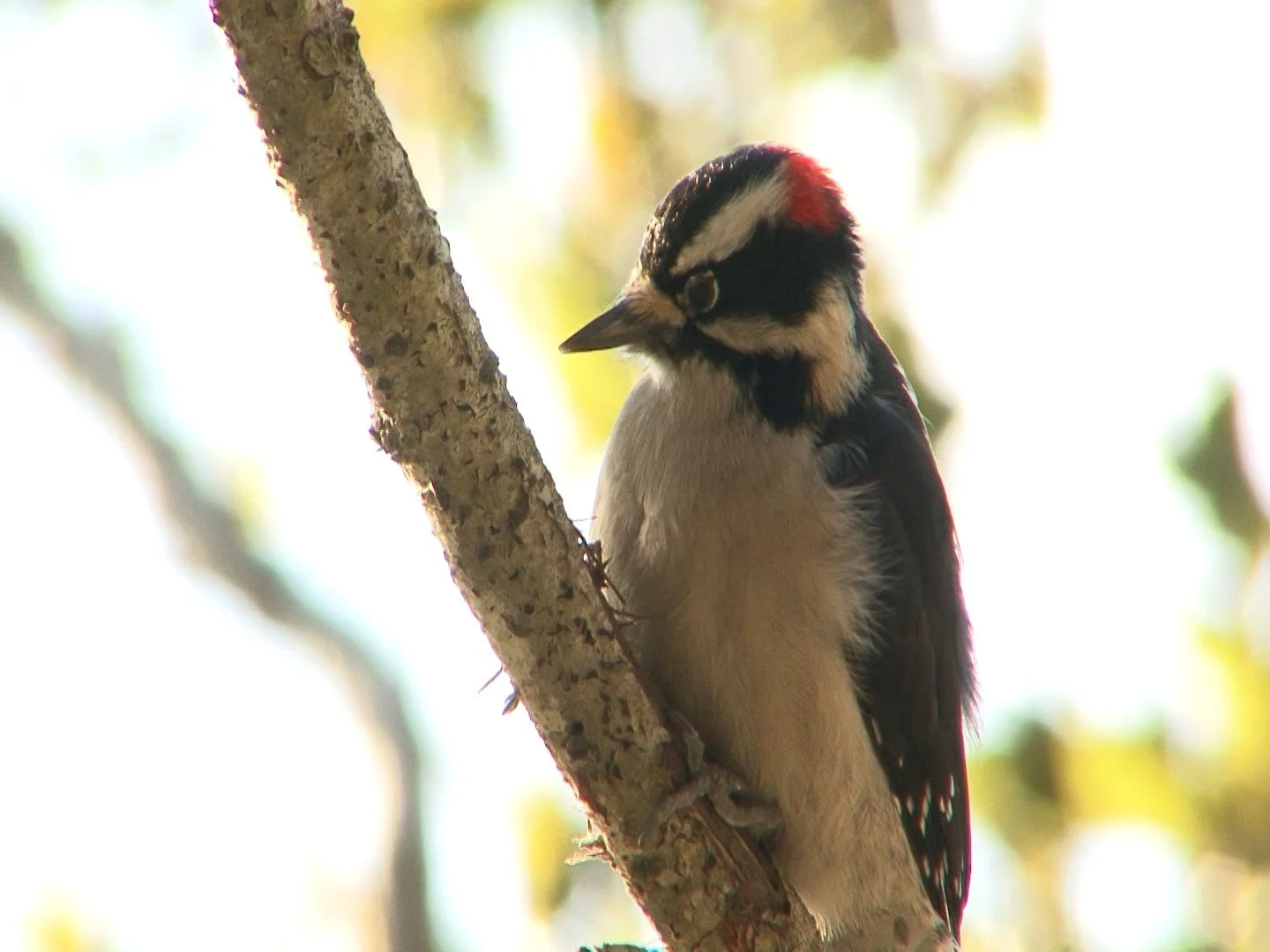
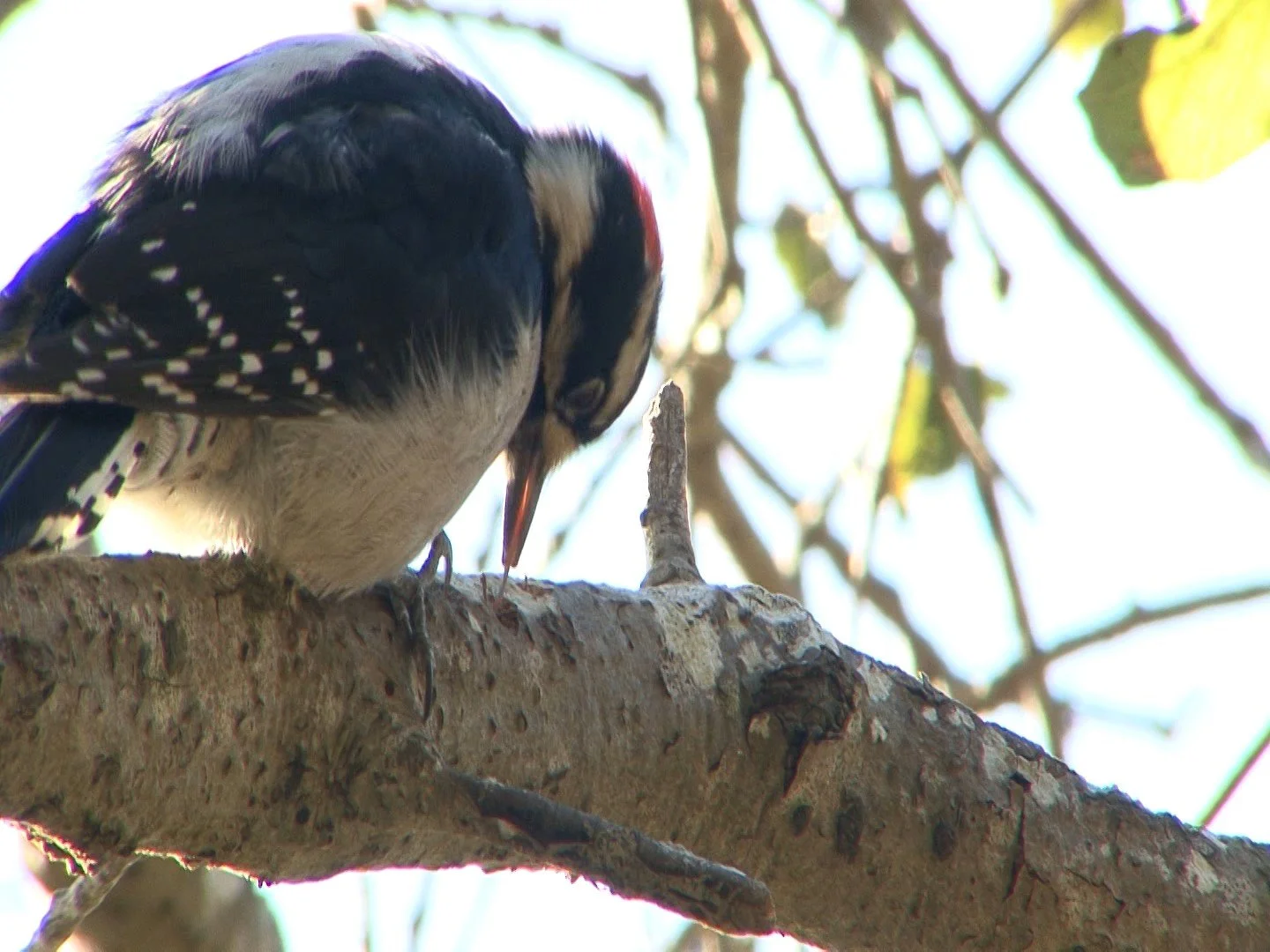
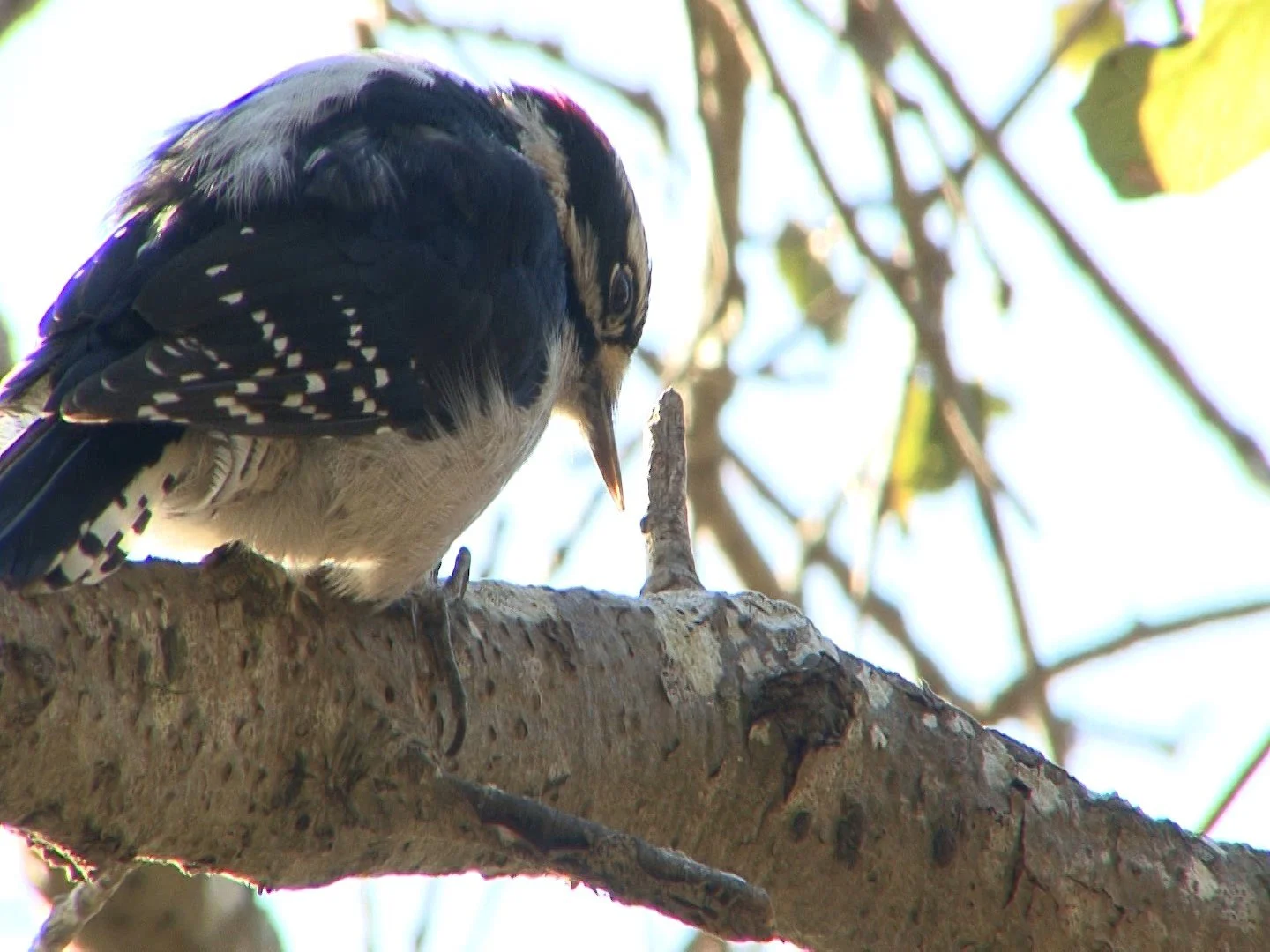
Like its larger cousin, the Hairy (video above), it exfoliates branches. The Hairy prefers the forest interior. The Downy prefers smaller branches or twigs at forest margins, and also public parks. For the Claremont Canyon backyard bird feeders among us, the Downy and Nuttall’s are the most likely to turn up. A woodpecker suet feeder is optimal for attracting woodpeckers by providing a place for the birds’ stiff tail.
While common, I don’t see the Downy as often as the Hairy from our Woodpecker Trail. Perhaps it’s micro-demographics, or just slim luck.
Downy Woodpecker Foraging Insect Tunnels
(Photographer © Jeffery Martin)
In the case of the Hairy, listen for a bold “squeak,” sort of like a rubber ducky. The Downy vocalizes a less bold and thinner-sounding “pip”. All three of these close cousins, the Nuttall’s, Hairy, and Downy, have similar black and white striping on the head. They are also sexually dimorphic, where males and females can be distinguished from one another. Males have a red crown … females do not.
Location 3
Click on map to enlarge
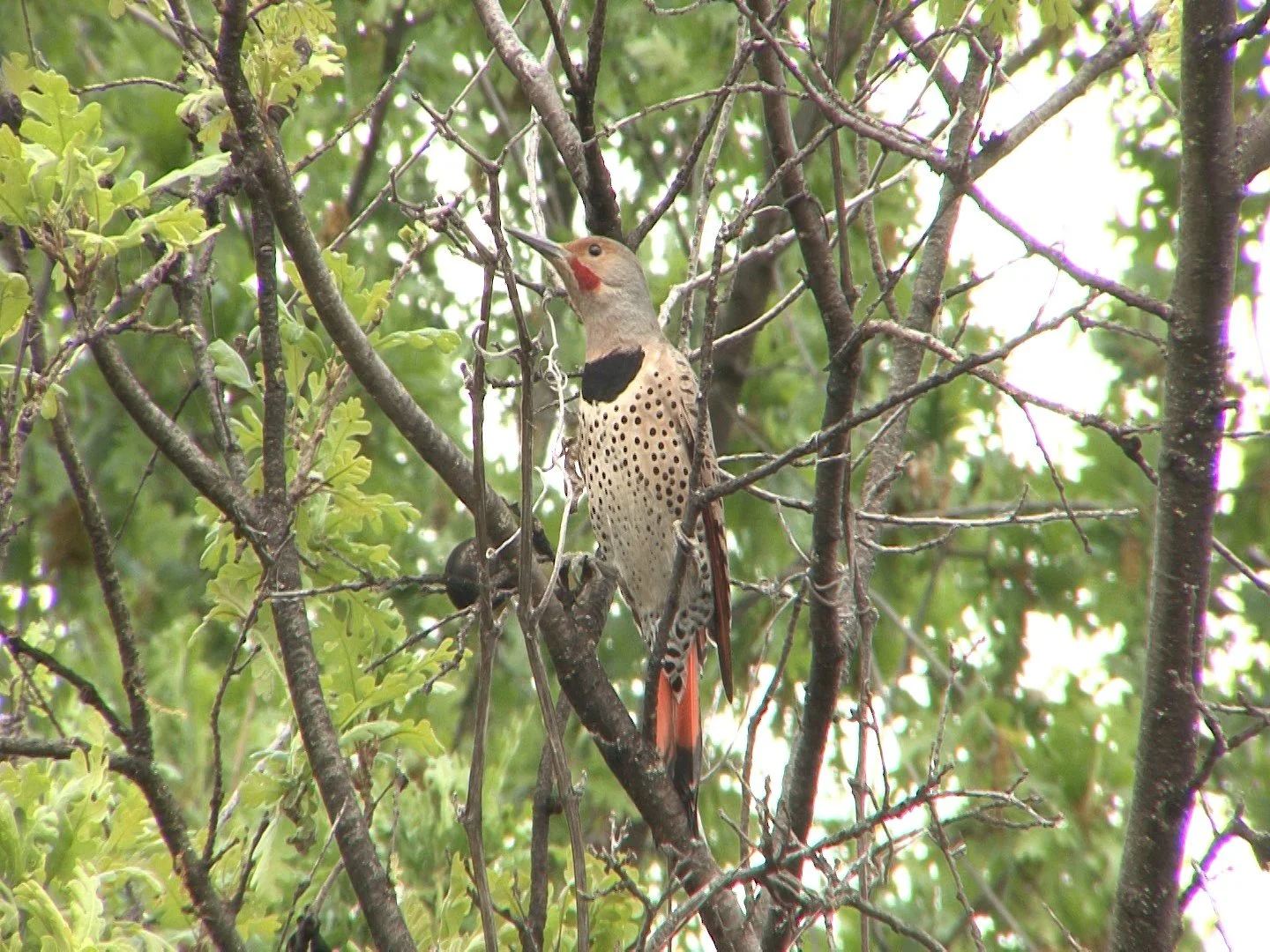
At the second switchback, we listen listen for a ricochet-vocalization or a very loud ki ki ki ki scream. It’s the exquisitely patterned Northern Flicker and it is the most widespread and readily visible woodpecker in North America, and the largest on the Woodpecker Trail. We have the western subspecies called the “Red-Shafted Flicker.” You may see it in flight before you hear it … the bird will grab your attention with its unmistakable, and flashy red underwings. At rest, attractive and multiple patterns of color catch the eye. Slender zebra-like stripes on a rust-orange back, contrasted with bold dark dots on a pale buff belly, topped with a crisp dark almost-crescent-shaped breast shield below the neck. Males and females look different with varying colorful patches of rust-orange, grey, and red on their heads.
Northern (Red-Shafted) Flicker (Photographer © Jeffery Martin)
The Red-shafted Flicker has a very long tongue … the longest of our six species … actually the longest in North America. When foraging, its tongue extends up to two inches out from its bill. All North American woodpeckers have curiously weird tongues. They are long, sticky, barbed and folded up around their skull when not in use. When in use, the tongue darts quickly in and out of the bill to probe and catch prey and is easily overlooked or impossible to see. With magnification and a careful eye, high speed camera, or slow-motion video, you might grab a look.
The Red-shafted Flicker’s long tongue is designed to probe and grab ants and other insects on the ground. The Red-shafted Flicker gobbles up more ants than any other Claremont Canyon woodpecker and is likely the only woodpecker you will see hanging out on the ground. Grassy fields bordered or dotted by trees are a good place to look for them. Most any place along the Woodpecker Trail, stay attuned to loud vocalizations and splashy red wings in flight.
Location 4
Click on map to enlarge
On the way to our next switchback, a Nuttall’s Woodpecker is often heard nearby. Also, there are four conspicuous live oaks, lined up, and drifting down hill along the west side of the trail. Continue up the trail and past these live oaks … then look back at them. Of the four trees, the second closest tree from the trail is covered with sap wells.
I discovered these some years back when I happened on a fellow birder with binoculars pointed attentively at this tree. It’s amazing how much birders learn from fellow birders as we compare notes about what we are or have seen and where. In this case, the fellow birder was observing a bright red male Summer Tanager, that would normally belong in the Southwest desert. When I returned again to see if I could spot the Tanager … no luck. But I mentally gasped when I noticed sap wells in this very same tree!
Unlike acorn granaries which are at the center of Acorn Woodpecker activity, sap wells are usually subtle, harder to find, blending in, and located a bit more on the periphery. Hence, one of the most intriguing foraging strategies goes unnoticed! These woodpeckers are accustomed to the traffic of humans using the trails. Venturing off the trail will disturb them. So, while blissfully enjoying the woodpeckers, please stay on the trails.
Just as the Acorn Woodpecker chisels its own acorn granary holes, this industrious feathered creature does the same with sap wells. The bird feeds on the sap, and also any insects that turn up in the wells. The wells are smaller than acorn granary holes and sort of randomly arranged up and down trunks, limbs, and branches. With some luck, you may see one or two of the Acorn Woodpecker family harvesting sap from their little wells.
Our sapsucking conversation takes us to another of our six woodpeckers, the Red-breasted Sapsucker. This woodpecker is the only one of our 6 that migrates and is seen here in the winter months. Our five other Claremont Canyon woodpeckers are year-round residents. So, like the Acorn Woodpecker, the Red-breasted Sapsucker sucks sap (no surprise?). The live oak we are looking at is extensively filled with both the Acorn Woodpecker sap wells and the Red-breasted Sapsucker wells, and they look quite different actually. The Red-breasted Sapsucker’s wells are smaller than the Acorn Woodpecker’s. Also, rather than being engineered and drilled in a more or less random configuration, the Red-breasted Sapsucker organizes sap wells by design… arranging them in neat horizontal circles around tree trunks. In the winter months, the Red-breasted sapsucker co-occupies this live oak tree.
Red-breasted Sapsucker (Videographer © Jeffery Martin)
Unlike the communal Acorn Woodpeckers that hang out in groups and are quite vocal, the Red-breasted Sapsucker remains rather quiet and solitary here, and far less often seen. Yet, their sap wells are ubiquitous throughout Claremont Canyon, most of them abandoned in years past, but perhaps the best evidence that this bird occurs here and has for a long time. When spotted, we see showy plumage of red on the head and chest, bleeding beautifully into orange and yellow down the breast. This is our only woodpecker of the six where females and males look alike.
Now, let’s be clear … Acorn Woodpeckers and Red-breasted Sapsuckers don’t really suck sap! They kind of lap it up. Studies of the Red-breasted Sapsucker tongue show structures on its tongue that help deliver sap to the throat. By the way, specialized tongue structures also occur in hummingbirds. Hummers are not sipping nectar or sap … they are lapping it. The Red-breasted Sapsucker as well as the Acorn Woodpecker cross paths with hummingbirds as hummers follow these woodpeckers and feed on their already excavated sap wells, including in the very live oak we are looking at. Whether or not you see a woodpecker, you may see a hummer lapping sap from a woodpecker well.
The tongue anatomy of Acorn Woodpeckers has not been researched, but by whatever means the Acorn Woodpecker’s tongue helps drink its sap, it is not by sucking. Again, the tongue of a woodpecker is hard to see as it darts in and out of the bill. But give it a try! While these two species of woodpeckers may also be gleaning insects from the sap, it's difficult to tell whether a given bird is drinking sap or eating insects. Believe it or not, the Acorn Woodpecker’s taxonomic species name is formicivorus … latin for “ant eater!” These birds are insect gleaners … often seen hopping and poking in and around limbs and branches.
Location 5
Click on map to enlarge
At the next switchback, about a hundred feet up the trail, is a perfectly-placed lookout bench in the shade of a eucalyptus grove, showing hikers expansive views of the Bay. But another creature also uses this grove as a lookout! Acorn Woodpeckers love to fly catch … and they do it a lot!! Look for one or more community members perched up high on horizontal bare branches. Then lift your binoculars and take a closer look. Watch these woodpeckers turn their heads right and left, up and down, this way and that, scouting for flying prey. Then lower your binoculars, and gaze a while. Wait for it! … wait for it! … then just at the just right moment, the Acorn Woodpecker will swoop to the air, snatch its prey, then return to the same perch or one nearby, all in the space of several seconds. Once having landed, if the insect is large, for example a dragonfly, you might be lucky and see it feeding on its prey, raptor style. It also may stash large insects in tree crevices for later eating.
This brings us back to hummingbirds. They fly catch too … and a lot. At home, in our backyard, when not foraging among our flowers, a hummer perches on a bare branch … a look-out … it’s head peering in all directions … until up in the air, catching a fly, and then flying back to the same or nearby perch. For both woodpeckers and hummers, flying insects are an important and staple part of their diet. Flies are high in protein, and an important food for their newborns. Most interesting is that hummers and acorn woodpeckers have so much in common!
So where are the acorns? It’s really true … Acorn Woodpeckers harvest and eat acorns (as if you didn’t know)! Some communal groups will have one main “granary”… a tree, blanketed with thousands of acorn holes, excavated for acorn storage … constructed with one hole for each acorn. Other communal groups will excavate several mini granaries with perhaps a few dozen to a few hundred acorns each. Mini granaries are the rule on the Woodpecker Trail. Acorns are of course harvested from oak trees, but granaries may be constructed in a variety of alternative tree types. To find hard-to-see mini-granaries in this location look for dead snags emanating from and in between live eucalyptus limbs and branches, camouflaged by leaves, dappled sun, and shade. I enjoy finding hidden ones and we’ll see more up ahead.
Acorn Woodpecker at Acorn Granary (Videographer © Jeffery Martin)
Location 6
Click on map to enlarge
Our route takes a detour from here through what looks to me … if I let my mind wander a bit … like a magical forest portal. The first few times I hiked the Stonewall-Panoramic Trail, I noticed hikers seeming to pop out of or disappear into this mysteriously shaded tunnel, and I became curious about where it led. One day I tried it and entered a delightful shaded riparian woodland, a creek, a small bridge, and then an expanse of sunlit hillside, sometimes referred to as Derby Canyon … where one is treated to an exquisite variety of native wildflowers. Many have been planted and nurtured by volunteers over the past few years.
Location 7
A fork in the trail leads either down to the UC Berkeley athletic field, or up the hill and several switchbacks to the semi-residential street, Panoramic Way. The hillside is a popular place for friends, families, and romantic couples to come and enjoy spectacular sunsets all year round. We will take the trail upward. I should mention, before we head up, that the riparian woodland we just exited is often occupied by Hairy Woodpeckers. Listen carefully, easier to hear than see, for the notable rubber ducky “squeak”.
Location 8
Click on map to enlarge
Once arriving at the residential street, Panoramic Way, glance west a hundred feet or so at the top of the utility pole. Acorn Woodpeckers have used this perch as a fly catching lookout. Every once-in-a-while, I will see two or three of them swooping for a few seconds into the air and then returning to their perch. We head east and north up Panoramic Way. The residential landscapes we pass are frequented by hummingbirds. Among the many Anna’s Hummingbirds, I have also seen Allen’s Hummingbird here, a California endemic that breeds here in the spring and summer.
Location 9
Click on map to enlarge
Up the road, where houses give way to shaded forest, keep an eye and ear out again for Hairy Woodpeckers and Red-Breasted Sapsuckers. Finally, we arrive at the top of Panoramic Way—the upper end of our Woodpecker Trail. Here, the paved road splits and we turn and walk to our left just a bit onto Panoramic Place. Between here and two large water storage tanks, a couple hundred feet down the road, is our woodpecker watching location.
Location 10
Click on map to enlarge
The area is rich with birdlife of many kinds … including at least three types of woodpeckers … and good looks … all within fifty to a hundred feet on either side of the road. This complicated mix of natural and human-made space provides homes and stop-offs for lots of diverse birdlife.
One can drive directly to the Panoramic Way summit as well … up the ‘scary” twists and turns of residential streets beginning near the UC stadium. I frequently drive up here. The summit of Panoramic Way at Panoramic Place is a complicated habitat. Fences, pavement, houses, signage, utility poles, wires, water tanks … bordered by cut and fallen trees, standing tree snags, and forests of tall conifer trees, live oaks, and a grassland-field provide splendid micro-habitats that attract a wide array of birdlife.
On multiple trips, one can see Western Bluebirds, three species of nuthatches, plenty of woodpecker-like Brown Creepers, a residential pair of Red-tailed hawks, a Black-headed Grossbeak, and Hermit Thrushes singing away … and much more … including at least three species of woodpeckers! The area is quite open on the north side of the road, but give the birds some space. If a bird looks alarmed or annoyed, step back a bit.
The Red-breasted Sapsucker is seen here occasionally in the winter months among the oak trees to the south side of the road. When not present, the familiar sap well circles around tree trunks and branches are always here. Since this woodpecker is rather vocally silent, one needs to visually scan the woodlands for signs of movement … or faint sounds of pecking. Hairy Woodpeckers are residents here and “share” this habitat with the Acorn Woodpeckers. Well … not quite ”share.” Territorial battles are vigorous … and frequent. Acorn Woodpeckers will mob the Hairy Woodpecker, who in turn, swoops here and there, harassing the mob. It’s hard to determine which bird is the intruder. Our resident Red-tailed Hawks and Ravens often do the same. On the wing, each is squabbling with the other over territorial rights.
This is the third habitat on our route where Acorn Woodpeckers are usually seen, and one of the best places to observe flycatching, acorn harvesting, and granary tending. On the north side of the road, scan the dead tree snags and tall conifers. The granaries are in the open … quite watchable. Some are constructed in the bare wood of a dead tree, while others are constructed in thick tree bark that’s deep enough to drill a hole and hold an acorn. Look carefully among the dead trees, and dozens or hundreds of granary holes will likely appear.
In the fall months, Acorn Woodpeckers gather acorns from live oaks on the south side of the road. Back and forth, several woodpeckers at a time, each with a harvested acorn in its bill … each flying back to a granary on the north side to tap its acorn into a granary hole that fits.
Through mastery and some trial and error, acorns are tapped in place, or moved around from one hole to another … Some new acorns need new holes, most do not. Granary maintenance takes place all year round as acorns dry out a bit and shrink and need to be moved to better fitting holes. “Tap tap tap” … “nope” … “try another one.”
Acorn Woodpeckers move around a lot at the granary, excavating or maintaining many holes at once. Often a granary hole is “remodeled” for a better fit. In other cases, new holes are excavated to handle newly harvested acorns as well as ones that require maintenance. It is lots of fun to watch up close through binoculars as one or more woodpeckers are busy moving, tapping, excavating, and trying a number of holes until a good fit is achieved. Also, notice woodpeckers on horizontal branches used as “anvils” as they chip acorns into pieces.
This location is also one of the best places to watch flycatching. The area is open and expansive. From here we can watch Acorn Woodpeckers fly from conifer tree to conifer tree, speak to other community members with “waka waka waka,” peer right and left and up and down to scout out prey, and swoop into the air to grab it.
To me, this place feels like a theater … wonderful for viewing its inhabitants … especially the woodpeckers. It’s also a terrific place to get to know several of its diminutive co-inhabitants whose habits, foraging styles, and appearance are a bit similar to the woodpeckers. Most notable are the Pigmy, Red-breasted, and White-breasted Nuthatches, and Brown Creepers. But that’s another story.
Thanks for joining me on the Claremont Canyon Woodpecker Route! Hope you enjoyed it and Happy Woodpeckering!
*Jeff Martin is a wildlife educator, naturalist, videographer, and woodpecker enthusiast. At his “day job” Jeff is a clinical psychologist and Associate Clinical Professor at UCSF School of Medicine, Department of Family and Community Medicine. Email: pelicanday@aol.com
Editing by Ruby J. Soto Cardona - Media and Outreach
General References
Backhouse, F. (2005). Woodpeckers of North America. New York: Firefly Books Ltd.
Bannick, P. (2025). Woodpeckers, A Year in the Life of North American Woodpeckers. Seattle WA: Mountaineers Books (Braided River).
Bent, A.C. (1939). Life Histories of North American Woodpeckers – Order Piciformes. Washington, D.C.: Smithsonian Institute.
Hill, G.E. (2010). Bird Coloration. Washington, D.C.: National Geographic Society.
Jackson, J.A. and Quellet, H.R. (2020). Downy Woodpecker (Dryobates pubescens), version 1.0 in Birds of the World (P.G. Rodewald, Editor). Cornell Lab of Ornithology, Ithaca, N.Y., USA.
Jackson, J.A., Ouellet, H.R., and Jackson, B.J. (2020). Hairy Woodpecker (Dryobates villosus), version 1.0. in Birds of the World (P. G. Rodewald, Editor). Cornell Lab of Ornithology, Ithaca, N.Y., USA.
Koenig, W.D. and Mumme, R.L. (1987). Population Ecology of the Cooperatively Breeding Acorn Woodpecker. Princeton, NJ: Princeton University Press.
Koenig, W.D., Walters, E.L., Stacey, M.T., Stanback, M.T., and Mumme, R.L. (2020). Acorn Woodpecker (Melanerpes formicivorus) version 1.0 In Birds of the World (P.G. Rodewald and B.K. Keeney, Editors). Cornell Lab of Ornithology, Ithaca, N.Y., U.S.A.
Lowther, P.E., Pyle, P., and Michael, A.P. (2020). Nuttall’s Woodpecker (Dryobetes nuttallii) version 1.0 In Birds of the World (P.G. Rodewald, Editor), Cornell Lab of Ornithology, Ithaca, N.Y., USA.
Martin, J.R. (2019-2025). Personal Consultations with Walter Koenig, Research Zoologist Emeritus, UC Berkeley. University of California Hastings Natural History Reservation, Carmel, CA.
Martin, J.R. (2014-2025). Field and Videographic Observations (primarily, University of California Hastings Natural History Reservation, Carmel Valley; Claremont Canyon East Bay Regional Preserve; Helen Putnam Sonoma County Park; Lake Solano and Putah Creek, Solano County: Talent, Oregon; Southeast Arizona).
Shunk, S.A. (2016). Peterson Reference Guide to Woodpeckers of North America. New York: Houghton Mifflin Harcourt.
Walters, E.L., Miller, E.H., and Lowther, P.E. (2020). Red-breasted Sapsucker (Sphyrapicus ruber) version 1.0 In Birds of the World (A.F. Poole, Editor), Cornell Lab of Ornithology, Ithaca, N.Y., USA.
Weibe, K.L. and Moore, W.S. (2024). Northern Flicker (Colaptes auratus) version 2.1 In Birds of the World (P.G. Rodewald and B.K. Keeney, Editors). Cornell Lab of Ornithology, Ithaca, NY, USA.
