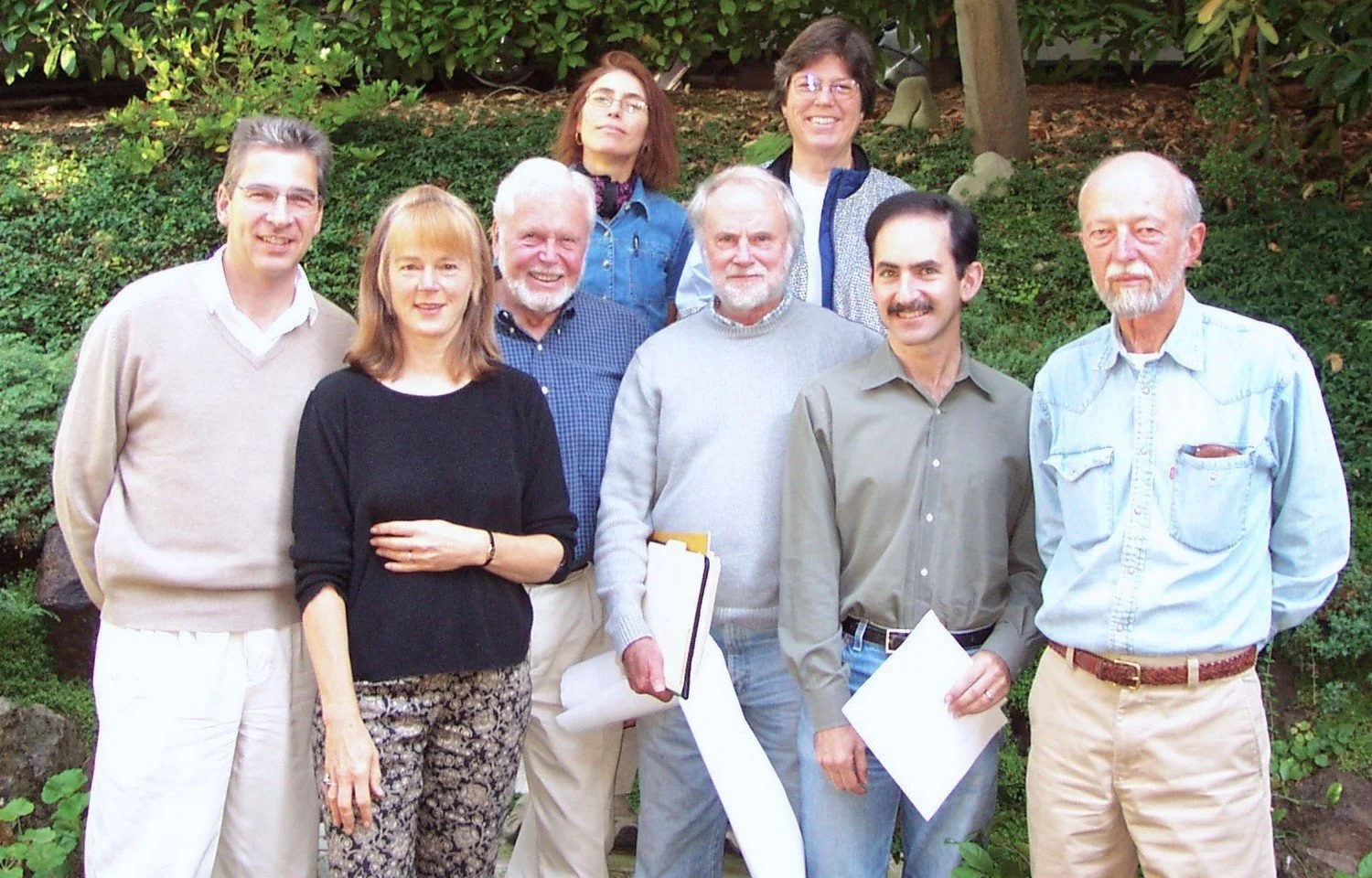
Eight of the original 12 founders of the Claremont Canyon Conservancy gathering in Tim’s yard in 2003 (left to right) Klaus Burmeister, Marilyn Goldhaber, Tim Wallace, Tamia Marg, Bill McClung, Joan Collignon, Barry Miller, and Joe Engbeck. Nancy Mueller, also one of the founders, took the picture.
November of 2026 marked the 25th anniversary of the Claremont Canyon Conservancy, a quarter of the way through the life of our volunteer-run organization, which was as founder Bill McClung once quipped “meant to last 100 years.”
Since November of 2001, when Bill, Tim Wallace, and ten other local residents filed with the California Secretary of State as a 501(c)(3) charity, volunteerism has remained a shining feature of the Conservancy. After 10 years as an all volunteer task force, we were ready to spread the idea that ordinary people could educate themselves about how to live more safely along the steep slopes of the Oakland and Berkeley Hills.
Neighbors were invited to step forward and become stewards “of a place where the city intermixes with nature, where most of the open land is public, and where all can help shape the future.” To establish the Conservancy, two hundred families joined, committing to donate $1,000 over 10 years. With promised donations and a small capacity-building grant from the federal government, the Claremont Canyon Conservancy was born.
Our outreach to neighbors was called our Founding Sponsor Program. Founding Sponsors would help wake up the landowners, both public and private, to the importance of wildfire safety. Early joiners were mostly people who had experienced firsthand the devastating Oakland Tunnel Fire of October 1991. Many had lost their homes in that fire. Others trembled as flames rushed toward their properties, only to swirl away in other directions. Virtually all of our Founding Sponsors witnessed the horrific aftermath of a fire that destroyed over 3,000 structures in two hours and took the lives of 25 people.
Our two main leaders were former logger and UC professor of agriculture Tim Wallace and Berkeley bookstore owner and local entrepreneur Bill McClung. Both men were known for their extraordinary “way with people” and “just do it” attitudes. Both passed away within months of each other in 2020-2021.
Other strong Conservancy leaders included the late Jerry Kent, a 41-year veteran of the East Bay Regional Park District, and the late Joe Engbeck, a naturalist writer, publisher, and the force behind The Friends of Claremont Canyon. Together, Jerry and Joe crafted a comprehensive Advocate Plan to guide the major landowners on what to do in 27 “polygons” of Claremont Canyon.
At first, our fledgling organization was unaware that the older group, The Friends of Claremont Canyon, existed. The Friends had advocated for public access to undeveloped lots in Claremont Canyon in the late 1970s. They successfully convinced the Park District to purchase the lots—including many small parcels drawn on a “paper map” a century before and given away to subscribers of the Examiner newspaper! The Park District needed to track down the parcel owners and make deals. This formidable task was given to Ralph Samuel, who tells the story in our Fall 2023 Newsletter of how the Claremont Canyon Regional Preserve was created in 1982 through the purchase of 208 acres for approximately $3 million.
The Friends and the Conservancy founders soon discovered that they had much in common and merged, resulting in a roster of experienced, environmentally attuned individuals capable of building good relationships with the canyon’s stakeholders. Stakeholders included the Park District, UC Berkeley’s “Hill Campus,” EBMUD, the City of Oakland, and several hundred residential households.
While talks were underway, many Conservancy members set out to experience the pleasure of hard work outdoors in the fresh air. We scoured old fire trails throughout Claremont Canyon and began to participate in their upkeep and repair. By working with other nonprofits, such as the California Native Plant Society and the Sierra Club, we learned that native vegetation was more resilient and generally more fire-safe than exotic vegetation. Thus began a strategy of favoring native plants over exotics wherever possible.
Our volunteers returned most often to Oakland’s 14-acre Garber Park at the base of Claremont Canyon and to UC’s 150-acre “Hill Campus” at the canyon’s upper reaches. Occasionally, we made forays into the 208-acre Claremont Canyon Regional Preserve to attack invading French broom. Our biggest volunteer project was the planting of hundreds of redwood seedlings in 2006 on UC land after the university cut and chipped thousands of eucalyptus trees onsite.
Around the same time, the largest landowner, the East Bay Regional Park District, embarked on a more modest program of cutting down eucs from the ridgelines to the north and east of the canyon and thinning the old eucalyptus plantation at the Stonewall entrance to the Preserve. They were able to remove additional eucs near homes and along roadsides, through a 2006 federal grant the Conservancy had obtained which was supplemented by Conservancy members living on Stonewall Road.
In addition to a focus on public lands, the Conservancy turned an eye to the residential population by organizing lectures and tours in the canyon. We became an early promoter of home hardening and defensible space at a time when such terms were unfamiliar to just about everyone. Fast-forward twenty-five years, and these terms and concepts have made their way into the policies of city governments and insurance providers.
The work of guiding homeowners and neighborhoods is now carried forward by other organizations, such as the Oakland Firesafe Council, the Berkeley Firesafe Council, our state and local governments and coalitions, and the insurance industry itself. We did our part in establishing the need to modify our homes and properties, and we are grateful to others now taking on the sometimes uncomfortable positions and tough decisions that homeowners must make.
Part II of the History of the Claremont Canyon Conservancy is slated for publication in 2027.
